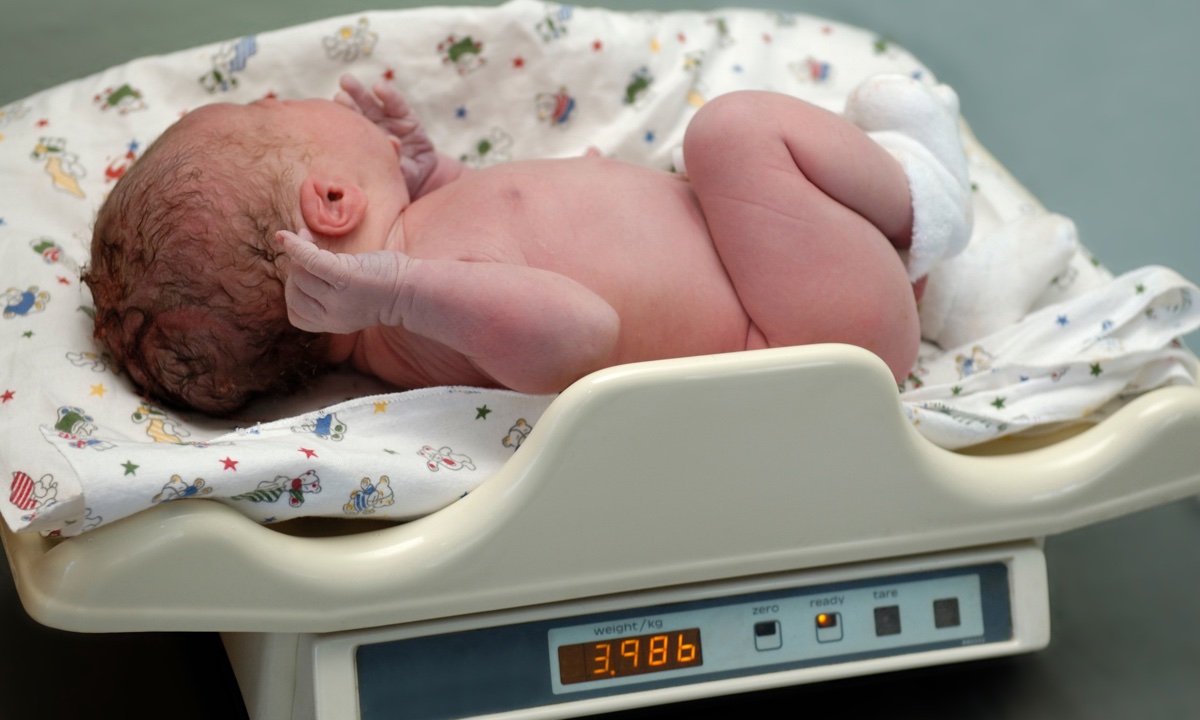
Test weighing, the practice of weighing a baby before and after feeding to estimate feeding volume, is a clinically accessible and noninvasive method for quantifying milk intake in breastfed infants.
In the nuanced field of lactation, tools that provide greater insight into feeding are invaluable. One key tool that embodies these qualities is the use of scales. As a lactation consultant, integrating scales into your practice can transform the way you assess, advise, and support nursing mothers. This blog post is dedicated to exploring the profound impact that scales can have in lactation practice. From measuring infants' weight gain to fine-tuning feeding strategies, scales offer information that can be crucial for both immediate decisions and long-term breastfeeding success. Join me as we delve into the practical applications of scales in lactation practice, and discover how this tool can enhance your work as a lactation consultant.
Many clinicians use test weighing with a digital scale to assess milk intake in breastfeeding infants. However, the evidence is mixed about the accuracy, precision, and usefulness of this method in the clinical setting. According to Haase et al., (2009), “The discrepancies in the literature regarding the accuracy of test weighing may be due to several factors, including the scale, the infant, or the technique,” (p. 151).
The Method
- To assess milk intake in a breastfeeding infant, clinicians first weigh the baby prior to the breastfeeding session and records the volume, typically in grams.
- Next, mother feeds the baby.
- Finally, baby is re-weighed, changing nothing (same clothes, diaper, blanket, etc.), to assess milk intake. The clinician records the volume in the same unit of measurement and then subtracts the final volume from the initial volume to arrive at the milk transferred volume.
Notes
- It is important that nothing changes with baby between the first and second weights to ensure no inappropriate change in weight. For example, if baby had socks on with the initial weight but they fell off during feeding and were not on during the second weight, it will look as if baby either lost weight or transferred less than he may have.
- Researchers found that infant moving (flailing arms and legs) resulted in more inaccurate results. They recommend tightly swaddling baby prior to weighing. They also recommend that baby is placed on the scale in the supine position with all blankets, clothing, burp cloths, etc., not touching the side of the scale. The scale should be placed on a hard, level surface. Haase et al., 2009, p. 152
- Measuring in grams is preferred as you will be able to recognize smaller changes, as compared to weighing in pounds and ounces.
- It is important to remember that test weighing is one snapshot in time. Babies often take varying amounts at feedings throughout the day. The location, time of the day, or the visit itself may affect the feeding quality, resulting in an unreliable milk intake assessment. In order to be able to fully assess baby’s milk intake, test weights should be done for every feeding for 24-hours.
How Accurate Does Your Scale Need to Be?
A common recommendation in lactation practice is that test weighing requires a scale accurate to 2 g. Scales with 1–2 g resolution are certainly useful, and some researchers and neonatal programs prefer them, particularly when evaluating very small milk transfers. However, the published evidence does not establish 2 g as a universal requirement. The guidance and research that do exist point to ±5 g.
- Academy of Breastfeeding Medicine (ABM) protocols. ABM Clinical Protocol #16, on breastfeeding the hypotonic infant, describes test weighing on an electronic scale with accuracy of at minimum ±5 g, with the infant weighed immediately before and after the feed under the exact same circumstances (Thomas & Marinelli, 2016). ABM Clinical Protocol #12, on transitioning the breastfeeding preterm infant from the NICU to home, uses the same ±5 g standard (Noble et al., 2018). Notably, both protocols address higher-risk infants, the populations in whom assessing milk transfer matters most.
- Validation research. When Haase et al. (2009) developed a standardized test weighing technique for preterm and high-risk hospitalized infants, they defined a difference of ±5 g between actual intake and test weight as clinically acceptable. Using their technique, correlations between test weight and actual intake were extremely high: r² = 0.998 for infants without leads and 0.997 for infants with leads.
- Community research. Esquerra-Zwiers et al. (2024) compared parent-performed infant test weights with bottle weights in community settings using a Tanita BD-815U scale, which reads in 2 g increments up to 6 kg and 5 g increments from 6 to 15 kg. The infants averaged about 8 months of age, so many were likely weighed in the 5 g range. Test weights agreed with bottle weights to within about 2 g on average, which the authors described as a clinically acceptable difference.
Precision versus clinical usefulness. In outpatient practice, you are rarely trying to determine whether a baby took 42 mL or 44 mL. A test weight is one data point, interpreted alongside feeding behavior, swallowing, breast assessment, output, weight trajectory, feeding frequency, supplementation history, and infant age. Because 1 g of weight gain corresponds to approximately 1 mL of milk, a 5 g increment represents roughly 5 mL, and a transfer of 65 mL versus 67 mL is almost never going to change your clinical management.
Finer resolution becomes more valuable when transfers are very small, such as distinguishing roughly 4 mL from 8 mL in a very young or medically fragile infant. Even then, the clinically meaningful conclusion is often simply “very low transfer,” rather than a management decision that hinges on whether the precise volume was 4, 6, or 8 mL.
It is also worth remembering that resolution can create an illusion of certainty. A scale that displays every 2 g does not establish that the infant consumed exactly the volume shown. Infant movement, positioning, changes in clothing or diapers, and the test weighing procedure itself all introduce error (Haase et al., 2009), which is why consistent technique matters as much as the scale you choose.
One practical caution: a scale’s resolution (the increments it displays) is not the same as its accuracy (how close the reading is to the true weight). When choosing a scale, look at the manufacturer’s stated accuracy, not just its display increments.
Bottom line: a medical-grade electronic infant scale with ±5 g accuracy is appropriate for routine weight assessment and pre- and post-feed test weighing in outpatient lactation practice. Scales with greater resolution may be advantageous when very small milk transfers must be quantified, but current evidence does not establish 1 g or 2 g resolution as a universal requirement for clinical lactation practice.
Pros
- Gives you insight into how baby is doing with weight (gain or loss since birth, since last visit, etc.)
- Could give you an idea of milk transfer
Cons
- Good quality scales can be expensive
- Some scales are heavy and bulky
- You must maintain you scale and have it calibrated regularly
Research
- The research is mixed on the accuracy of using test weights to assess milk intake.
- A 2002 study from Scanlon et al. looked at 32 studies which evaluated means of measuring or estimating milk intake. In the 9 studies that measured breastmilk intake via test weights, results demonstrated that correlations between the test method and validation standard were high. According to Scanlon et al. (2002), “Study results also confirm that test weighing the infant before and after a feeding is useful for measuring milk intake and may be applied in research, clinic, or home settings. In addition, we found that test weighing a sampling of feeds produced correlations that were only slightly lower than test weighing all feeds in a 24-hour period, indicating that such sampling may be useful for clinic or home assessment when all feeds cannot be measured,” (p. 250).
- Rankin et al., in 2016, evaluated the accuracy of test weighing to assess breastmilk intake in 68 infants in a NICU. All test weights were done using a Medela BabyWeigh II digital scale and results were compared to actual gavage feed intake. They found a high degree of correlation between the gavage volumes and the test weights, suggesting that test weighing is an accurate measure of estimating breastmilk intake.
- Haase et al., in 2009, found test weighing to be an accurate and objective measure of milk intake in a sample of 19 infants in a NICU. They also developed a technique to accurately test weigh preterm and high-risk infants in NICU.
Takeaway
- Use a medical-grade electronic infant scale with accuracy of at least ±5 g, and check the manufacturer’s stated accuracy, not just its display increments. A scale with 1–2 g resolution can help when you need to quantify very small transfers.
- Ensure consistency between weights and with method of weighing.
- Do not rely on test weighing as only measure of breastfeeding success. Be sure to use critical judgement and assess mother baby dyad as a whole when assessing feeding success.
Tools I Recommend
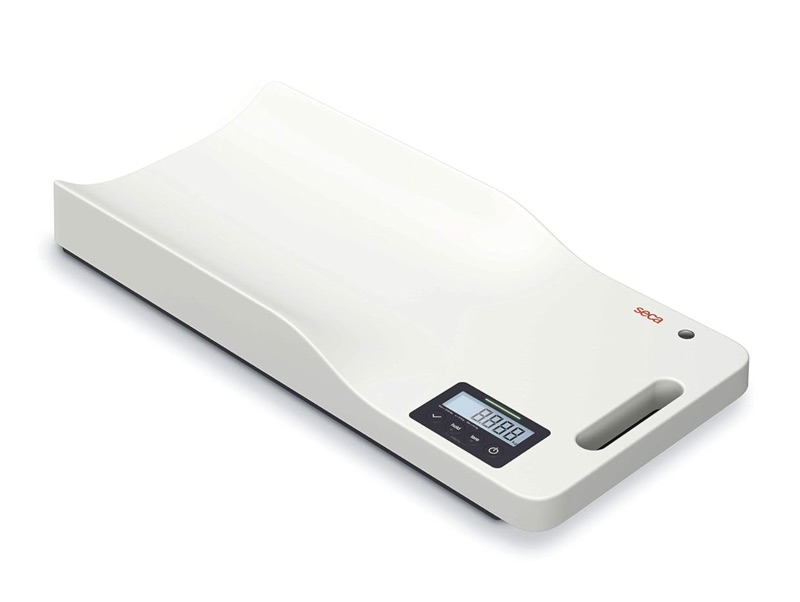
These are the two scales I recommend for lactation practice. Both are medical-grade, and both include a breast-milk intake function (BMIF) that calculates the difference between pre- and post-feed weights for you, so you are not doing the subtraction by hand mid-visit.
- Seca 334 Mobile Digital Baby Scale: light, portable, and runs on batteries or a power adapter, which makes it well suited to in-home visits. It reads in 5 g increments up to 10 kg (10 g above that), consistent with the ±5 g accuracy described in the ABM protocols.
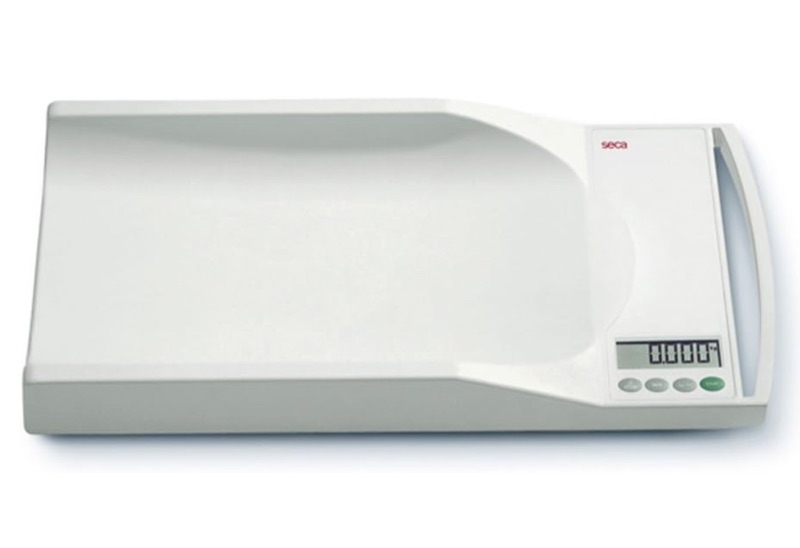
- Seca 333 i EMR-Ready Baby Scale with Wi-Fi: sends weights directly to your electronic medical record over Wi-Fi, which saves charting time and reduces transcription errors. A good choice if your practice or clinic documents electronically.
As an Amazon Associate, I earn from qualifying purchases. This does not change the price you pay.
References
Esquerra-Zwiers, A. L., Heter, M., Perecki, A., Jackson, O., Jongekryg, D. A., & Yurk, B. (2024). Comparison of human milk bottle with infant/toddler test weights in the community setting. BMC Nutrition, 10, 105. https://doi.org/10.1186/s40795-024-00911-4
Haase, B., Barreira, J., Murphy, P. K., Mueller, M., & Rhodes, J. (2009). The development of an accurate test weighing technique for preterm and high-risk hospitalized infants. Breastfeeding Medicine, 4(3), 151–156. https://doi.org/10.1089/bfm.2008.0125
Noble, L. M., Okogbule-Wonodi, A. C., Young, M. A., & the Academy of Breastfeeding Medicine. (2018). ABM Clinical Protocol #12: Transitioning the breastfeeding preterm infant from the neonatal intensive care unit to home, revised 2018. Breastfeeding Medicine, 13(4), 230–236. https://doi.org/10.1089/bfm.2018.29090.ljn
Rankin, M. W., Jimenez, E. Y., Caraco, M., Collinson, M., Lostetter, L., & DuPont, T. L. (2016). Validation of test weighing protocol to estimate enteral feeding volumes in preterm infants. The Journal of Pediatrics, 178, 108–112. https://doi.org/10.1016/j.jpeds.2016.08.011
Scanlon, K. S., Alexander, M. P., Serdula, M. K., Davis, M. K., & Bowman, B. A. (2002). Assessment of infant feeding: The validity of measuring milk intake. Nutrition Reviews, 60(8), 235–251. https://doi.org/10.1301/002966402320289368
Thomas, J., Marinelli, K. A., & the Academy of Breastfeeding Medicine. (2016). ABM Clinical Protocol #16: Breastfeeding the hypotonic infant, revision 2016. Breastfeeding Medicine, 11(6), 271–276. https://doi.org/10.1089/bfm.2016.29014.jat