When a baby needs to be supplemented, it is often recommended to avoid bottles and use alternative methods. This is thought to protect the breastfeeding relationship while also ensuring adequate intake for the infant. However, no evidence exists demonstrating the efficacy of one alternative over another.
This post will provide an indepth dive into alternative feeding techniques typically used with breastfed babies, covering cup feeding, syringe feeding, supplemental nursing systems, the Neotech Bridge, and finger feeding. I'll explain how and when these methods are typically used and give you an overview of what the research has to say about each of these methods.
My goal is to equip you with a balanced and detailed understanding of each method, exploring their mechanisms, applications, and an understanding of what the scientific literature has to say about them. I will dive deep into the nuances of these alternative feeding methods, ensuring that you are well-prepared to guide and support dyads needing to supplement and choosing alternative methods.
Cup Feeding
Cup feeding is a method where an infant is fed with a small disposable plastic or paper open-top cup. According to the “Cup feeding is an alternative way to feed infants when they are unable to feed directly at the breast and when infant feeding items cannot be cleaned properly. Cup feeding can be used with babies of all ages and is also safe for premature and many ill babies." 1
Cup feeding is an easy, low-cost method of offering a supplement to an infant. This is the preferred method, globally speaking, because of its ease of cleaning and wide availability of cups (no special equipment needed). 2 Exam tip: If there’s a question asking about the preferred method for supplementing a baby, the answer will be cup feeding. This is because the ease of cleaning is particularly relevant for infection control in low- and middle-income countries. 3
Pros:
- Readily available- no special equipment necessary
- Easy to clean
- Ability to control milk intake- avoid overfeeding
Cons:
- Can be messy
- Baby does not use sucking skills to transfer milk which may inhibit transition to breastfeeding
While it’s relatively easy, low-cost, and no special equipment is needed, cup feeding isn’t widely practiced or preferred at most hospitals in the United States. A 2016 Cochrane Review reported bottles were preferred over cup feeding in a hospital setting. 3 This could be related to the mess associated with cup feeding, there is a greater incidence of spillage, or the potential for desaturation. A couple of studies demonstrated lower oxygen saturation with cup feeding than with breastfeeding.4,5
Moreira et al. expressed concern with using the cup feeding method in preterm infants long-term as it may hinder transition to breastfeeding since baby does not use sucking skills to transfer milk. "This condition induces a modification of his/her oral behavior. This change in sucking behavior is evident mainly in the difficulty in opening the mouth and the anteroposterior movement of the preterm infant's tongue." 2
In my own practice, I’ve used cup feeding occasionally in the hospital setting with healthy, full-term babies needing to be supplemented. In private practice, I provide all of the moms I see prenatally with a cup and syringes for doing antenatal hand expression. I teach that the cup and syringes can be used to supplement baby if needed. I rarely have moms use cup feeding as a method to supplement after the first day or two of life.
Based on what we know about using cup feeding as an alternative method to supplement breastfeeding babies, it is probably an ok method to use in full term babies for a short period of time. It is important to be aware of how much milk is spilled to ensure that baby receives adequate volume. In a preterm baby, it would be more judicious to choose a method that allows baby to practice sucking skills, reduces any stress, and has limited spillage to ensure baby is getting adequate intake.
Syringe Feeding
Oral syringes can be used to offer supplement if needed. The size of the syringe will depend on the age of the baby and the volume needed for supplementation. To offer supplement via syringe, the tip of the syringe in placed in the baby’s mouth (in the center or in the corner of the mouth) and a small volume is pushed into baby’s mouth. Baby is allowed to swallow the milk and then the procedure is repeated. Babies generally do not suck on the syringe.
In the first day or two of life, I’ve helped many moms use 1ml and 5ml syringes to supplement babies when their stomach volume (and mom’s milk volume) is quite small. After the first few days, if baby continues to need to be supplemented, it is best to increase the size of the syringe so that the parents aren’t having to continuously refill the syringe. The use of the syringe for supplementing baby has a fairly short shelf life. Once baby is needing more than about 15ml of milk supplemented, this process can become long and tedious and unsustainable. In my practice, I would suggest another method for ongoing supplementation after the first few days of life.
Few researchers have studied this method of offering a supplement. Buldur et al. compared syringe feeding to finger feeding in 70 preterm infants in Turkey. They reported babies who were syringe fed had slower transition to breastfeeding, lower milk intake, reduced comfort, and reduced sucking abilities than babies who were finger fed. 6 Shebilouysofla et al. compared cup, syringe, and finger feeding in 99 preterm infants in Iran. They found no significant difference between the methods. 7 Rahmani et al compared syringe feeding and cup feeding in 70 preterm infants in Iran. They found the time to reach full oral feedings longer in the syringe feeding group. 8
Since the evidence we have is limited and restricted only to preterm infants outside of the United States, it is difficult to translate those findings into recommendations. I think this is a reasonable method in the first few days of life when the volume needed for supplement is very small and the consistency of colostrum is thick, potentially reducing the risk of choking.9 Drawing up 1-2ml of colostrum in a syringe and feeding it to the baby may be a great boost to mom’s self-efficacy, particularly if you’re using a 1ml syringe! However, without much evidence, and no evidence for healthy, full term babies, I don’t recommend this method beyond that use case.
Pros:
- Low tech method
- May boost self-efficacy when using small syringes with small volumes of colostrum
- Oral syringes not very difficult to access, particularly in the hospital
Cons:
- no published evidence about this method for supplementing healthy, full term babeies
- not feasible or sustainable for larger supplementing volumes
Supplemental Nursing System
A supplemental nursing system is a device consisting of a container that holds milk and a tube taped to the mother’s breast alongside the nipple that delivers milk while baby sucks at the breast. There are a few commercially available versions of this device, but it can also be constructed using a feeding tube and a large volume syringe.
The supplemental nursing system (SNS) or supplemental feeding tube device (SFTD) is a method recommended by many lactation professionals. It is thought to help protect the breastfeeding relationship while also delivering extra nutrition to babies at the breast. An SNS can be used in cases of infant with weak or disfunctional suck, in mothers with previous breast surgery, insufficient milk supply, or in cases of relactation or adoption.10
I have helped moms to use an SNS in both the hospital and the home setting. My typical use case if a baby that needs to be supplemented due to poor maternal milk supply, excessive weight loss, or slow weight gain. In babies that have a strong, coordinated suck, offering the supplement at the breast can simplify a triple feeding plan. It can eliminate the need for someone else to be available to offer the supplement to the baby and/or can eliminate the need for pumping after every feeding. It can be a very handy tool, however, it is not without its challenges.
A couple of studies have evaluated moms’ experiences using an SNS. While the moms largely expressed the usefulness of the tool, they also expressed how difficult it was to use, how it required more than one set of hands, and was difficult to clean and assemble.10,11 The mothers that I have worked with expressed similar sentiments. If I am using an SNS with a mother, I typically use a 5f feeding tube with an Enfit connector and a 30ml or 60ml syringe with an Enfit connector. This simplifies the process of filling, assembling, and cleaning the tool for the parents. These supplies are often less expensive, as well.
To date, there is very little research about the efficacy, benefits, or risks of the supplemental nursing system. One study conducted in Turkey in 2021 looked at how the SNS impacted transition to full breastfeeding compared to babies supplemented with bottles in preterm infants. They found no difference between the two groups.12
Pros:
- Reduces time when triple feeding since baby is taking supplement while also breastfeeding.
- May reduce the need for pumping after some or all breastfeeding sessions in triple feeding plans if baby sucks well at the breast.
Cons:
- Some systems can be difficult to access- Not carried in stores and may not be readily accessible and easy to access online
- Some systems are pricey
- Parents report they are often difficult to use
- Often requires more than one set of hands to get baby latched and SNS in place and milk flowing
- Some systems difficult to clean
Neotech Bridge
The Neotech Bridge is a new device designed for supplementing baby at the breast. It is essentially a nipple shield with the feeding tube built in. The end of the tube has an Enfit connector that connects easily to a syringe with an Enfit connector.
Achieving a latch and getting the tubing of the SNS in place can be tricky. Some providers use a nipple shield to help ease latching while using an SNS. The Neotech Bridge simplifies the process of supplementing at the breast by combining the tubing, syringe, and nipple shield into an easy-to-use system.
As I said before, many of the moms that I’ve worked with using the SNS found it to be challenging and not feasible. I have recently been offering the Bridge in cases where it was appropriate. This tool has helped reduce the burden of triple feeding while allowing moms to help preserve breastfeeding in an achievable way. When I began offering the Bridge as a method for supplementing at the breast, mothers verbalized almost unanimously the ease of using the product. Moms were able to latch baby easily and then manage the flow from the syringe with just one hand. Additionally, cleaning the product is very simple as there are only three parts (the Bridge and the syringe with plunger removed). I saw much greater success in the ability for moms to supplement at the breast using the Neotech Bridge than I ever saw with moms using a supplemental nursing system or a feeding tube with syringe at the breast.
One concern that I’ve heard from some lactation professionals is around introducing a nipple shield if it’s not needed. There is a dearth of evidence around nipple shield use in general. We don’t have any definitive evidence that nipple shield use reduces milk transfer or impacts maternal hormone expression. We don’t have any definitive evidence that nipple shield use shortens the duration of breastfeeding or that nipple shield use is irreversible. However, we have some indication that a nipple shield can be feel like a life ring to a new mom experiencing breastfeeding difficulties. Triple feeding can be very difficult and is not sustainable for very long.13 For a mother trying to preserve breastfeeding while also providing a supplement to her baby, simplifying the process with the Bridge may mean the difference between a mother meeting her breastfeeding goals or not. The benefit of reducing the mom’s stress, making supplementing achievable, and contributing to mom’s breastfeeding self-efficacy outweighs the potential risks of adding a nipple shield to the mix.
Since the Neotech Bridge is a new product, we have no published research around the efficacy, benefits, or risks. If you work at a facility that has the capacity to study this tool in a clinical setting, reach out to the company.
Pros:
- more simple to use and assemble than a traditional SNS
- Reduces time when triple feeding since baby is taking supplement while also breastfeeding.
- May reduce the need for pumping after some or all breastfeeding sessions in triple feeding plans if baby sucks well at the breast.
Cons:
- pricey
- only available via Neotech website
- no research
Finger Feeding
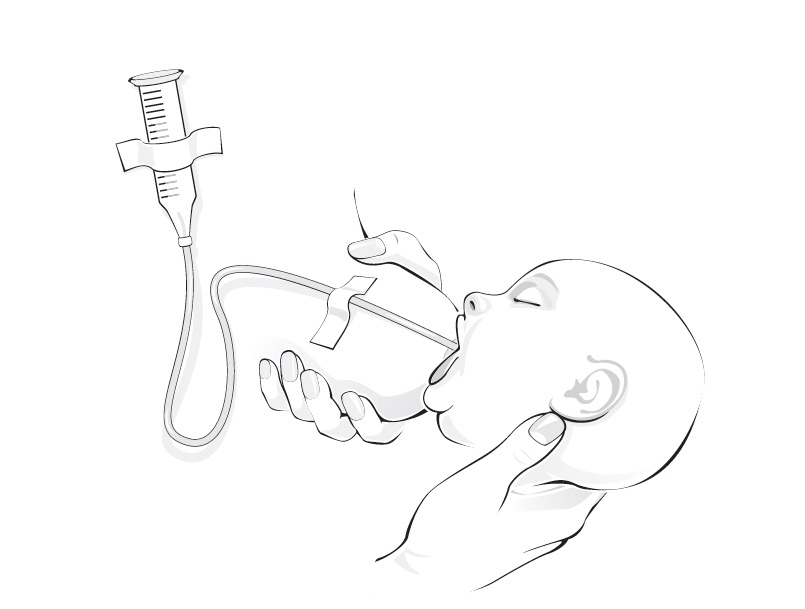
Finger feeding is a method of supplementing a baby that uses a small tube taped alongside a caregiver’s finger that allows baby to suck and milk is delivered via the tubing. It can be accomplished using a modified SNS, a syringe with a feeding tube, or the Hazlebaker Finger Feeder. Little evidence exists regarding the efficacy, safety, or risks associated with finger feeding.
A few studies have evaluated using finger feeding in the NICU setting with preterm infants. Moreira et al. compared finger feeding to cup feeding in a group of 53 preterm infants in a NICU in Brazil. They found significantly higher milk loss and longer feeding times with cup feeding compared to finger feeding. 2 Buldur et al. compared finger feeding to syringe feeding in 70 preterm babies in a NICU in Turkey. They found that babies who were finger fed had higher weight gain, transitioned to breastfeeding sooner, had shorter hospitalizations, and demonstrated higher comfort levels compared to those who were syringe fed. 6 In a similar study, Shebilouysofla et al., compared time to oral feeding between three alternative feeding methods: cup, syringe, finger feeding in 99 preterm infants in a NICU in Iran. The found no difference in outcomes between the three alternative feeding methods. 7 Neither of these studies reported any poor outcomes with the finger feeding method.
One benefit of finger feeding that other methods like cup feeding and syringe feeding lack is the ability for babies to practice sucking skills and be rewarded with milk when sucking. Sucking while receiving supplementary feedings may be important for the transition to breastfeeding. Karabayir studied finger feeding in full-term babies after discharge from the hospital as a method to help infants who were having trouble latching to the breast. “The finger feeding method is accepted as a physiological method that facilitates the transition to breastfeeding and improves sucking and respiratory coordination”. 14
In my own practice, I’ve only used finger feeding a couple of times. Many mothers needing to supplement in the hospital often choose to supplement via bottle. This could be due to nurses and providers in non-Baby-Friendly Hospitals being less familiar with alternative feeding methods, parents being uncomfortable with unfamiliar feeding devices, or some other reason. Moms tend to be more open to supplementing at the breast if they have to use an alternative method, or enlist the help of their partner to feed the baby with a bottle, in my experience.
What method should you recommend?
So how do you know what method to recommend? The Academy of Breastfeeding Medicine Clinical Protocol #3: Supplementary Feedings in the Healthy Term Infant says that when selecting a method to provide supplement to a breastfeeding baby, several things should be considered: cost, availability, ease of use, ease of cleaning, stress to the infant, the amount of time it will take infant to take an adequate volume, the anticipated length of use, the experience of the staff with the method, and whether the method will facilitate transition to breastfeeding. 15 You should also consider the age of the baby and mom's breastfeeding goals.
Understanding the variety of alternative feeding methods for supplementing breastfed babies is a vital aspect of lactation care. It is also vital that you understand what the research says about these methods. We need to know what researchers have learned, what situations these methods are best for, and what are the potential risks to using each of these methods.
It is important to acknowledge that our understanding of these methods is still evolving. Currently, we have limited evidence about the efficacy, benefits, or risks associated with these alternative feeding techniques. This lack of comprehensive data calls for caution and a careful, individualized approach when recommending these methods to nursing mothers. Each case should be evaluated on its own merits, with a keen understanding of the unique needs of both mother and child.
The gap in our knowledge underscores the need for more research in this area. Rigorous studies are essential to reinforce our understanding and provide a stronger evidence base for these feeding methods. By expanding our knowledge, we can improve outcomes for breastfed infants who require supplementation and ensure that the guidance we offer as lactation consultants is both scientifically sound and aligned with the best interests of the families we support.
Do you want to learn my Method for History Taking at a visit?
Click here to download the free guide.
*Note: Videos added to give visual explanations only of the discussed method. The content in the video may not be up-to-date with current evidence-based practice.
References
“Cup Feeding Infants during Emergencies.” Centers for Disease Control and Prevention, Centers for Disease Control and Prevention, 3 Mar. 2023, www.cdc.gov/nutrition/emergencies-infant-feeding/cup-feeding.html.
Moreira, C., Cavalcante-Silva, R., Funjinaga, C., & Marson, F. Comparison of the finger-feeding versus cup feeding methods in the transition from gastric to oral feeding in preterm infants. 2017; 96:585-591.
Flint, Anndrea, et al. “Cup feeding versus other forms of supplemental enteral feeding for newborn infants unable to fully breastfeed.” Cochrane Database of Systematic Reviews, 2007, https://doi.org/10.1002/14651858.cd005092.pub2.
Dowling, Dowling, Donna A., et al. “Cup-feeding for preterm infants: Mechanics and safety.” Journal of Human Lactation, vol. 18, no. 1, 2002, pp. 13–20, https://doi.org/10.1177/0890334402018001
Freer Y. A comparison of breast and cup feeding in preterm infants: eJects on physiological parameters. Journal of Neonatal Nursing 1999;5:16-21.
Bulder, E., Baltaci, N.Y., Terek, D., Yalaz, M., Koroglu, O., Akisu, M., & Kultursay, N. Comparison of the Finger Feeding Method Versus Syringe Feeding Method in Supporting Sucking Skills of Preterm Babies. 2020; 15:703-706.
Alinezhad Shebilouysofla, Parinaz, et al. “Effect of Cup, Syringe, and Finger Feeding on Time of Oral Feeding of Preterm Neonate’s: A Randomized Controlled Clinical Trial.” Journal of Health, Population and Nutrition, vol. 41, no. 1, 2022, doi:10.1186/s41043-022-00336-4.
Rahmani, Sara, et al. “Effects of Feeding Nozzle and Cup Feeding on Reaching the Time of Full Oral Feeding in the Premature Infants in the Neonatal Intensive Care Unit.” Iranian Journal of Neonatology, vol. 9, no. 1, Mar. 2018, pp. 65–70, doi: 10.22038/ijn.2018.26771.1357.
Genna, Catherine Watson. Supporting Sucking Skills in Breastfeeding Infants. Jones & Bartlett Learning, 2023.
Borucki, Lynne C. “Breastfeeding mothers’ experiences using a supplemental feeding tube device: Finding an alternative.” Journal of Human Lactation, vol. 21, no. 4, 2005, pp. 429–438, https://doi.org/10.1177/0890334405277822.
Penny, Frances, et al. “Use of a supplemental feeding tube device and breastfeeding at 4 weeks.” MCN: The American Journal of Maternal/Child Nursing, vol. 48, no. 6, 2023, pp. 334–340, https://doi.org/10.1097/nmc.0000000000000962.
ÇALIKUŞU İNCEKAR, Müjde, et al. “An alternative supplemental feeding method for preterm infants: The supplemental feeding tube device.” TURKISH JOURNAL OF MEDICAL SCIENCES, vol. 51, no. 4, 2021, pp. 2087–2094, https://doi.org/10.3906/sag-2009-323.
Boies, Eyla G., and Yvonne E. Vaucher. “ABM Clinical Protocol #10: Breastfeeding the late preterm (34–36 6/7 weeks of gestation) and early term infants (37–38 6/7 weeks of gestation), second revision 2016.” Breastfeeding Medicine, vol. 11, no. 10, 2016, pp. 494–500, https://doi.org/10.1089/bfm.2016.29031.egb.
Karabayir, Nalan, et al. “The Finger Feeding Method and Relactation.” Cureus, 2022, doi:10.7759/cureus.24044.
Kellams, Ann, et al. “ABM Clinical Protocol #3: Supplementary Feedings in the Healthy Term Breastfed Neonate, Revised 2017.” Breastfeeding, 2022, pp. 796–806, doi:10.1016/b978-0-323-68013-4.00040-7.